The JavaScript Assignment = operator
The assignment operator = stores a value in a variable: let x = 5. It's a single equals sign, not to be confused with == or ===, which compare. Compound forms like += and *= combine an operation with assignment.
Overview
= assigns: it puts the value on the right into the variable on the left. let count = 0, name = "Ada". It's the most basic operator there is, and the most common beginner trap is mixing it up with comparison. One equals sign assigns; two or three compare. if (x = 5) assigns 5 to x (and is always truthy), a bug, while if (x === 5) checks whether x equals 5, which is almost always what you meant.
There's a family of compound assignment operators that do an operation and assign in one step: +=, -=, *=, /=, %=, **=, and the logical ones &&=, ||=, ??=. So x += 5 is x = x + 5, and the handy x ??= 10 assigns 10 only if x is null or undefined.
Assignment is itself an expression that returns the assigned value, which enables (rarely needed) chaining like a = b = 0. More usefully, the left side can be a destructuring pattern (const { name } = user or [a, b] = [b, a]) to assign several variables at once. And remember const bindings can't be reassigned, so = on a const after declaration throws.
Syntax
x = value          // assign
x += 5             // compound: x = x + 5
x ??= 10           // assign only if x is null/undefined
a = b = 0          // chained (both become 0)
const { name } = user  // destructuring assignment

// don't confuse with comparison:
if (x === 5) { ... }   // compare (not x = 5)
Example
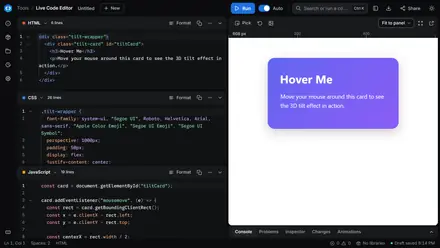
<pre id="out" style="font:15px ui-monospace,monospace"></pre>
<script>
  let total = 0;
  total += 10;
  total *= 3;

  let name;
  name ??= 'Guest'; // assigns because name is undefined

  document.getElementById('out').textContent =
    'total: ' + total + '\n' +
    'name:  ' + name; // total: 30 / name: Guest
</script>
Best practices
- Use
=to assign and === to compare; a classic bug is writing=in anif. - Use compound operators (
+=,*=,??=) to combine an operation with assignment. - Use destructuring assignment to set multiple variables from an object or array.
- Remember const can't be reassigned;
=on it after declaration throws.
Frequently asked questions
What is the difference between =, == and ===?
= assigns a value; == compares with type coercion; === compares without coercion. Use = to assign and === to compare.What does += mean?
x += 5 is shorthand for x = x + 5. The same pattern works for -=, *=, /= and others.What does ??= do?
Why is if (x = 5) always true?
= assigns 5 to x and the expression evaluates to 5 (truthy). You almost certainly meant x === 5.