JavaScript Formatter
Beautify JavaScript instantly.
About the JavaScript Formatter
What is a JavaScript formatter?
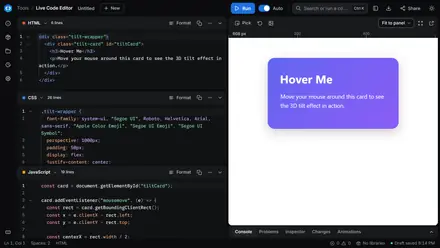
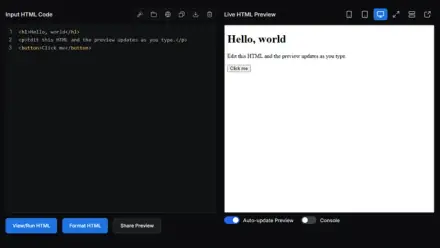
A JavaScript formatter takes crushed, minified, or messily written JS and rewrites it with consistent indentation, sensible line breaks, and readable spacing. This one formats live: paste code into the left editor and the beautified version appears on the right as you type, with syntax highlighting on both sides. It understands modern JavaScript, including arrow functions, template literals, destructuring, classes with private fields and async/await, because it tokenizes the language properly instead of guessing with regexes.
The formatting engine is the battle-tested js-beautify library, bundled locally with this page: nothing is fetched from a CDN at runtime and your code never leaves the browser. That also makes it tolerant, even incomplete or syntactically broken snippets get best-effort formatting instead of an error, which is exactly what you want when cleaning up code mid-edit.
How to Use This Tool
- Add your code. Paste it into the left editor, click Open file, or hit Sample to see it work.
- Watch it format. The output updates live; there's no button to press.
- Tune the style. Pick 2 spaces, 4 spaces, or tabs; choose where opening braces go; and decide whether your blank lines are preserved.
- Take the result. Copy it or download it as a
.jsfile, the size chips show what changed.
Example
A function squeezed onto one line will be converted to a properly braced and indented block:
Input: one line
function add(a,b){if(a>b){return a+b}else{return b-a}}Output: formatted
function add(a, b) {
    if (a > b) {
        return a + b
    } else {
        return b - a
    }
}
The formatter does not touch your logic, so the else branch stays exactly as written rather than being rewritten into an early return.
Common Use Cases
- Reading minified code: Expand a production bundle or an inline script into something you can debug.
- Cleaning up snippets: Normalize code collected from consoles, docs, and Stack Overflow before it enters your project.
- Enforcing a brace style: Convert between attached (K&R) and new-line (Allman) braces in one pass.
- Reviewing third-party scripts: See what a tracking snippet or embed code actually does.
- Preparing examples: Format code consistently for articles, slides, and answers.
Validating instead? Try the JavaScript Validator, format TypeScript or React/JSX, or browse all our free developer tools.
Frequently Asked Questions
Does formatting change what my code does?
No. Beautifying only touches whitespace, line breaks, and indentation, and tokens are never added, removed, or reordered, so the formatted code runs exactly like the original.
Can it handle minified JavaScript?
Yes, that is its bread and butter. A single-line minified file expands into properly indented statements, blocks, and functions. Variable names stay as they are, since unminifying names back to something meaningful is impossible, since that information is gone.
Which JavaScript syntax is supported?
Modern ECMAScript: arrow functions, template literals, destructuring, spread, classes with private fields and static members, async/await, optional chaining, and modules. The tokenizer-based engine is also tolerant of code fragments that would not parse standalone.
What do the brace style options mean?
Attached (the default) keeps the opening brace on the same line as its statement, K&R style. New line moves every opening brace onto its own line, Allman style. End expand is a hybrid that attaches braces but expands the ends of chained constructs like } else {.
Why is there no minify mode?
Safely minifying JavaScript requires a full parser to respect automatic semicolon insertion and scope, a naive whitespace stripper can silently change behavior. Rather than ship something risky, this tool focuses on beautifying; use a build tool like terser for production minification.
Is my code uploaded anywhere?
No. The formatting library is bundled with the page and everything runs locally in your browser, no CDN calls, no server processing, no logging. It works offline once loaded.